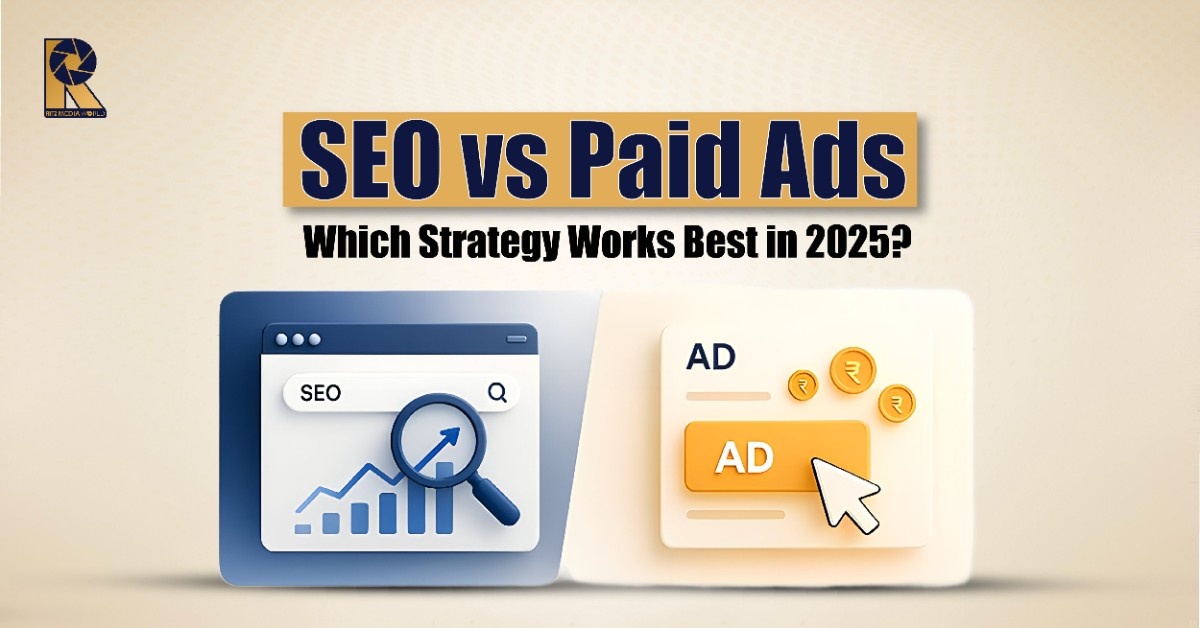
Short answer: neither wins on its own. In 2025, the best marketers combine SEO and paid ads, timed and budgeted for how fast you need results, how long you want them to last, and how competitive your category is. Here’s a clear, beginner-friendly guide to decide your mix (with simple math you can copy).
What changed in 2025 (and why it matters)
- AI summaries reduce clicks from Google. When users see an AI summary (a.k.a. AI Overviews), they click traditional links less than when no summary appears. In a 2025 analysis, users clicked a result link in ~8% of visits with summaries vs ~15% without. That means you must earn the mention inside summaries and diversify traffic. Pew Research Center
- Third-party cookies aren’t going away (for now). Google pivoted in 2025: Chrome did not automatically kill third-party cookies; it moved to a user-choice approach. Practically, remarketing and measurement stayed more stable than many expected (still plan for a cookieless future, but panic isn’t required).
SEO in 2025: strengths,
limits, and when it shines
What SEO does best
- Compounding traffic: quality content earns rankings, links, and brand trust over time.
- Higher user intent over the long run: top organic positions still grab disproportionate attention (organic position #1 averages far higher CTR than ads). First Page Sage
- Durable unit economics: once a page ranks, incremental visits often cost ~₹0 in media.
Where SEO struggles
- Time to value: expect 3–6 months for meaningful traction in a typical market.
- AI Overviews cannibalize some clicks: you must structure content (clear answers, schema, FAQs) to be cited, and build other channels so you’re not search-dependent.
Best-fit scenarios
- Considered purchases, B2B/SaaS, local services with repeatable queries, categories where you can publish useful, evergreen content.
Paid Ads in 2025:
strengths, limits, and when they shine
What pays best
- Immediate, controllable volume: switch on Search/PMax/Meta and get traffic this week.
- Targeting & testing: validate offers, headlines, and audiences quickly, then feed winners into SEO and lifecycle marketing.
- Remarketing still viable (thanks to Google’s 2025 cookie approach + first-party data), though you should build consented lists anyway.
Where paid struggles
- Ongoing cost: stop paying → traffic stops.
- Auction pressure: CPCs rise; creatives fatigue.
- Lower average CTR vs top organic (ads ≈ ~1–3% CTR; organic #1 ≈ ~40% in some studies, directionally, organic earns more clicks when you rank). Your mileage varies by query & intent. First Page SageHigherVisibility.
Best-fit scenarios
- New launches, time-sensitive promos, niches you don’t rank for yet, precise audience/geo targeting needs.
A simple decision framework (choose your mix)
Ask three questions:
- Speed: Do you need the pipeline now?
- If yes, the weight is paid higher rate in the first 60–90 days.
- If no/steady, start with SEO foundations and a light “always-on” paid layer.
- Unit economics: Can you afford to buy growth?
- Use this quick rule: Max CPC = Allowable CPA × Conversion Rate (CVR).
- Example: If your allowable CPA is ₹1,000 and landing-page CVR is 4%, Max CPC = ₹40. If auctions exceed ₹40, fix the page/offer or shift budget.
- Durability: Do you want compounding returns?
- If yes, invest in SEO every month (content + links + UX), then use paid to fill gaps or accelerate winners.
Budget playbooks (starter mixes)
- Local services (leads today): 60% Paid (Search + Local + Remarketing), 40% SEO (service pages, city pages, reviews).
- D2C/E-commerce (scaling): 50% Paid (Shopping/PMax + Meta), 35% SEO (category & PDP content, FAQs, how-to), 15% Email/SMS/Loyalty.
- B2B/SaaS (considered sales): 40% Paid (Search + LinkedIn retargeting), 45% SEO (problem/solution hubs, comparison pages), 15% Webinars/Community.
- New category/brand launch: 70% Paid in month 1–2 to validate the offer, then taper to 50/50 by month 4 as SEO assets start ranking.
(Treat these as starting points; adjust to CAC/LTV reality.)
What to expect (timelines
& KPIs)
Paid (first 30–45 days):
- Time to impressions: hours–days.
- Focus KPIs: CTR, CPC, CVR, CPA, ROAS, assisted conversions.
SEO (first 90–180 days):
- Time to traction: weeks–months, depending on competition.
- Focus KPIs: indexed pages, impressions, non-brand clicks, rank for priority terms, assisted conversions, revenue from organic.
Reality check: multiple independent studies show SEO often outperforms PPC on long-term ROI (varies by industry), while PPC provides speed and precision. You’ll likely need both, just not in equal amounts all the time.
90-Day hybrid plan (copy this)
Month 1 (Lay the rails)
- Analytics: GA4 events, clean UTMs, server-side tracking where possible.
- SEO: fix technical (speed, CWV), build/refresh the 10 most valuable pages; add FAQ schema & comparisons (“X vs Y”).
- Paid: launch Search (high-intent exact/phrase), PMax/Shopping (if e-comm), Meta remarketing. Create 1 lead magnet to build first-party lists.
Month 2 (Prove & improve)
- SEO: publish 6–8 helpful articles (problem → solution), add internal links; secure 3–5 relevant backlinks.
- Paid: A/B test one big thing (offer/landing) per channel; expand to close-variant keywords only if CPA holds.
- Lifecycle: 3-email nurture (welcome, proof, offer).
Month 3 (Scale what works)
- SEO: build a “topic hub” with pillar + cluster pages; add comparison & pricing explainers.
- Paid: push budget to top quartile ad sets/keywords; start lookalikes/modelled audiences from high-quality leads.
- Community/owned: webinar or tool (calculator), WhatsApp/Email list growth.
How AI summaries change your playbook
- Write for answers, not just rankings: lead with concise answers, then depth.
- Make your brand “citable”: clear author bios, sources, updated stats, schema (FAQ, HowTo, Product, Review).
- Diversify demand: email, community, PR, and creator partnerships so you’re not fully dependent on blue links. (Clicks drop when AI summaries appear, plan accordingly.)
Quick math cheats
- Max CPC (break-even): Max CPC = Allowable CPA × Landing CVR
- Allowable CPA (target CAC/LTV): Allowable CPA = LTV ÷ Target LTV:CAC
- Example: If LTV ₹9,000 and you want LTV:CAC = 3:1, allowable CPA = ₹3,000.
- SEO payback (very rough): If a page brings 800 visits/month at 2.5% CVR and ₹1,200 margin per order → 20 sales × ₹1,200 = ₹24,000/month. If it costs ₹60,000 to produce/promote, the payback ≈ 2.5 months after ranking.
The bottom line
- Need results fast? Start with paid, but fix your offer + landing first (that lowers CAC everywhere).
- Want compounding ROI? Invest monthly in SEO, it’s your margin machine.
- Smartest move in 2025: run a hybrid plan. Use paid to test and scale offers; use SEO to compound the winners; use owned channels to protect yourself from platform changes.
For the best advertisement rates, Contact us :-
9220516777
info@ritzmediaworld.com
402-404, 4th Floor Corporate Park, Tower A1 Sector 142, Noida, Uttar Pradesh, India