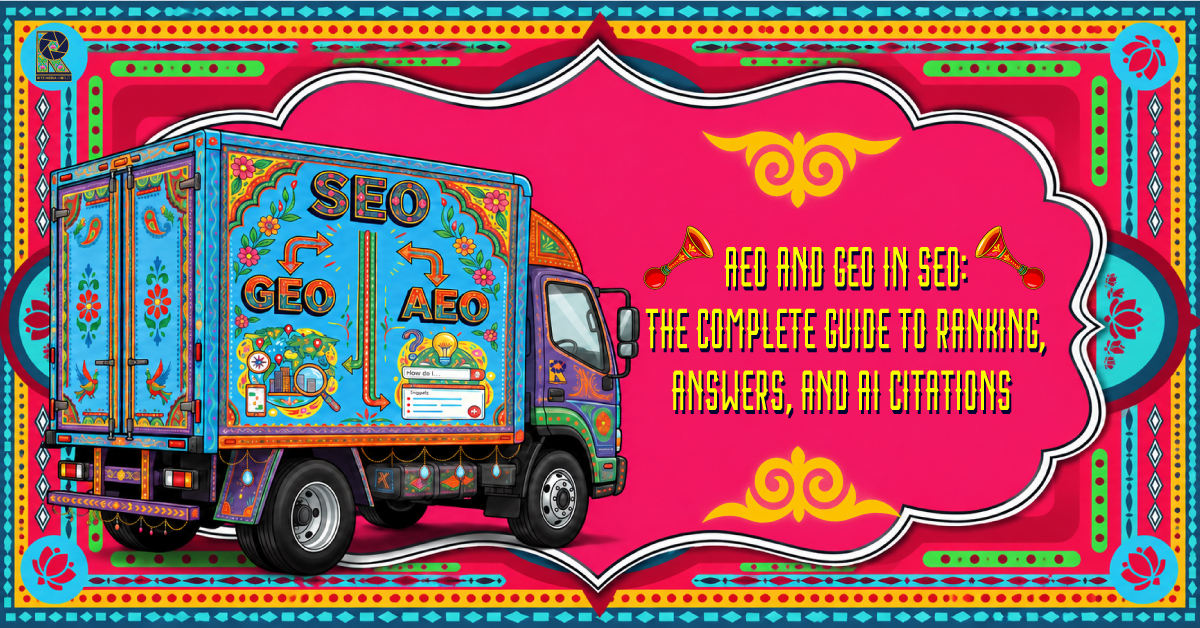
AEO and GEO in SEO: The Complete Guide to Ranking, Answers, and AI Citations
Search is not over when you hit ten blue links. One search can now set off an AI Overview from Google, give way to an answer provided by a voice assistant, or even result in a summary inside ChatGPT, Gemini, or Perplexity - no clicks required. That’s how two practices every marketer must know about today have emerged: AEO (Answer Engine Optimization) and GEO (Generative Engine Optimization).
While both are based on Search Engine Optimisation, there is a totally new approach to keywords, structuring, and authority needed to optimize for AEO and GEO in SEO. In this guide, we’ll tell you everything you need to know about AEO and GEO in SEO, why entity and semantic SEO became so important, and how you can create ranking content, answer, and earn AI citation at once.
What Is AEO (Answer Engine Optimization)?
Answer Engine Optimization involves the act of presenting information such that it can be retrieved and presented by AI-based search engines, voice assistants, and featured snippets as the answer to your question. It is not simply about trying to rank higher but about becoming the answer through featured snippets, People Also Ask widgets, Google AI Overviews, and voice search results.
Research has indicated that questions asked in the form of a query are much more likely to produce an answer by AI, which is why using heading questions and providing direct answers have become crucial ranking factors.
What Is GEO (Generative Engine Optimization)?
The Generative Engine Optimization process involves optimizing your content to be quoted, cited, or generated by AI-based generators such as ChatGPT, Gemini, Claude, and Perplexity. In contrast to AEO, which requires an answer to be crafted in a particular way, GEO involves earning a spot within a multi-source AI-generated answer.
GEO does not reward keyword stuffing. The research on the visibility of content in generative engines has shown that referencing credible sources, using statistics, quoting experts, and being clear in semantics can significantly improve the likelihood of getting your content cited by the AI generator – but keyword stuffing cannot do that at all.
Going Beyond AEO and GEO: The Rise of Entity SEO and LLMO
Now that AI search technology has evolved, there are two more important terms that are gaining prominence: entity SEO and LLMO (Large Language Model Optimization).
What is an SEO Entity?
An SEO entity is any unique object - a person, a brand, a product, a place, or a notion - that a search engine or AI-powered system could identify, classify, and associate with other entities within the Knowledge Graph of the engine. Entity SEO helps build semantic links between all related objects in order to help search engines and AI-powered platforms know not only about the content itself but also who you are and what topics you cover as a domain authority.
Entity mapping, topical authority, and structured data play an essential role here. As opposed to optimizing a page for one keyword, entity SEO creates a set of semantically linked content.
What is LLMO?
LLMO means creating content in a way that makes it easy for language models to understand, trust, and cite. This entails semantically marking up web pages in HTML, structured data without any mess, server-side rendering (many LLM crawlers cannot process JavaScript), and topical content clusters rather than one-off pages.
Also, you will hear adjacent concepts floating around in 2026: GXO (Generative Experience Optimization), which involves preparing content for autonomous AI agents and agentic commerce, and AIO (AI Optimization), a more general umbrella concept. These frameworks do not compete; they simply approach the same thing from a different angle - being relevant where answers are created.
SEO, AEO, and GEO: How They Work Together
SEO is still the base layer. Crawlability, page speed, internal linking, structuring, and technical SEO are what make a page eligible to be ranked, answered, or quoted in the first place. No matter how clever your AEO or GEO efforts are, a slow, disorganized, and inaccessible page will not recover.
It’s like building three layers of a house:
SEO helps you rank and get discoverable on classic search engines.
AEO helps you get extracted and presented as an answer.
GEO helps you get quoted in the AI-generated response.
One single optimized page can play all three roles at once, and this is the reason why some of the most effective content marketing tactics for 2026 will consider SEO, AEO, and GEO as one process as opposed to three independent tactics. To implement effective AEO, GEO, and SEO strategies, businesses can partner with a best SEO agency in Noida that understands modern search trends and helps improve online visibility across traditional and AI-powered search platforms.
Content Optimization for AEO, GEO, and AI-based Search Engines
1. Start Each Section With a Direct, Answer-First Opening
Just after every heading of your content, provide your answer in about 40-60 words, followed by the rest of your content. The answer-first structure is what AI-powered overviews by search engines, featured snippets, and voice assistants need.
2. Use Headings Formulated as Questions
Write your H2s and H3s in the form of questions like, "What is entity SEO?" or "How does LLMO improve AI visibility?" Query-based questions trigger much more frequent AI answers compared to normal keyword phrases.
3. Establish a Subject Matter Authority via Entity and Semantic SEO
Organize content around a specific entity or topic and link related pages together internally. Search engines and generative AI prefer to see a site with topical expertise instead of an individual SEO'd page trying to win in isolation.
4. Use Structured Data as a Clarity Layer
Schema does not automatically generate better rankings, but it confirms the information that's already there to the machine. Article schema helps with understanding content type and authorship; FAQ schema works well with rich results and AI extraction; and Organization schema improves entity identification in AI systems.
5. Improve E-E-A-T & Off-Page Authority
Most of the time, brand mentions found within AI answers appear in content from third-party sites rather than owned content. Thus, off-page optimization factors such as reviews, mentions, links, and citations from other websites matter the same for GEO visibility as on-page optimization factors do.
6. Focus on Long-Tail Intent Keywords Rather Than On High-Volume Ones
More specific long-tail keywords work better than more general high-volume keywords because they fit the user's intent better and they sound closer to the phrase that users entered into the AI tool. Work on optimization of one keyword per page and semantically-related secondary keywords only.
7. MEnsure Good Technical SEO & Crawling
Good technical SEO and crawling are critical in the age of AI searches. Fast page loading speed, mobile-first indexing, correct site structure, and server-side rendering become even more important now. Almost all LLM crawlers face issues in working with JavaScript pages and thus, their crawling affects your ability to be found.
Is SEO Dead Because of AEO and GEO?
No. SEO is growing, not dying. AIO-powered search has created additional surfaces to optimize for, but the basics of building a technically excellent, authoritative, and well-constructed website are precisely what make any particular web page a candidate to appear as an answer or referenced by an AI engine in the first place. Companies that view AEO and GEO as an extension of SEO are best placed for sustained visibility.
FAQs
What does AEO stand for in SEO?
Answer Engine Optimization. Organizing the information in such a way that AI tools, voice assistants, and featured snippets could extract it as a direct answer.
What does GEO stand for in digital marketing?
Generative Engine Optimization. It allows content to get cited or summarized by AI tools like ChatGPT, Gemini, Claude, and Perplexity.
What is entity SEO, and how does it affect AI search?
Entity SEO creates clear signals around your brand, product, or idea that help AI systems categorize them properly. It is important because AI systems rely on entity relationships, rather than keywords, when determining what to cite.
What is LLMO?
Large Language Model Optimization. It structures and tags content, using semantic HTML and structured data; so LLMs can understand and trust it.
Does keyword stuffing help with AEO or GEO?
No. Studies show it doesn't improve AI citation rates. Citation of sources, use of stats, and semantic optimization work much better.
Do I need to choose between SEO, AEO, and GEO?
No. One optimized page can rank in classic search, get featured snippet, and be cited by AI at the same time.
End Thoughts
SEO using AEO and GEO does not replace traditional SEO but rather builds on it to expand into a new space where answers are being generated instead of linked. Businesses can stay relevant even as searches are shifting to featured answers and AI-based searches through the application of good technical SEO along with content that is entity-based and semantic in nature.
To stay ahead in the changing digital landscape, partnering with Ritz Media World can help businesses leverage advanced SEO strategies, content optimization, and AI-focused search solutions.