Your audience won't read your mission statement. But show them a story? They'll stay till the last second.
That's not a content trend. That's just how people work. We've always responded to stories, around fires, in cinemas, on screens we carry in our pockets. What changed is that brands finally figured out they can use that instinct. And somewhere in the middle of all this, corporate brand films stopped being a "nice to have" and became something brands genuinely can't afford to skip.
I'm not talking about the kind where a CEO sits in a glass cabin, button-down shirt, reading carefully off a script while the camera pretends it's candid. I mean proper, cinematic, story-driven productions that make you feel something about a company, before you've even thought about buying from them.
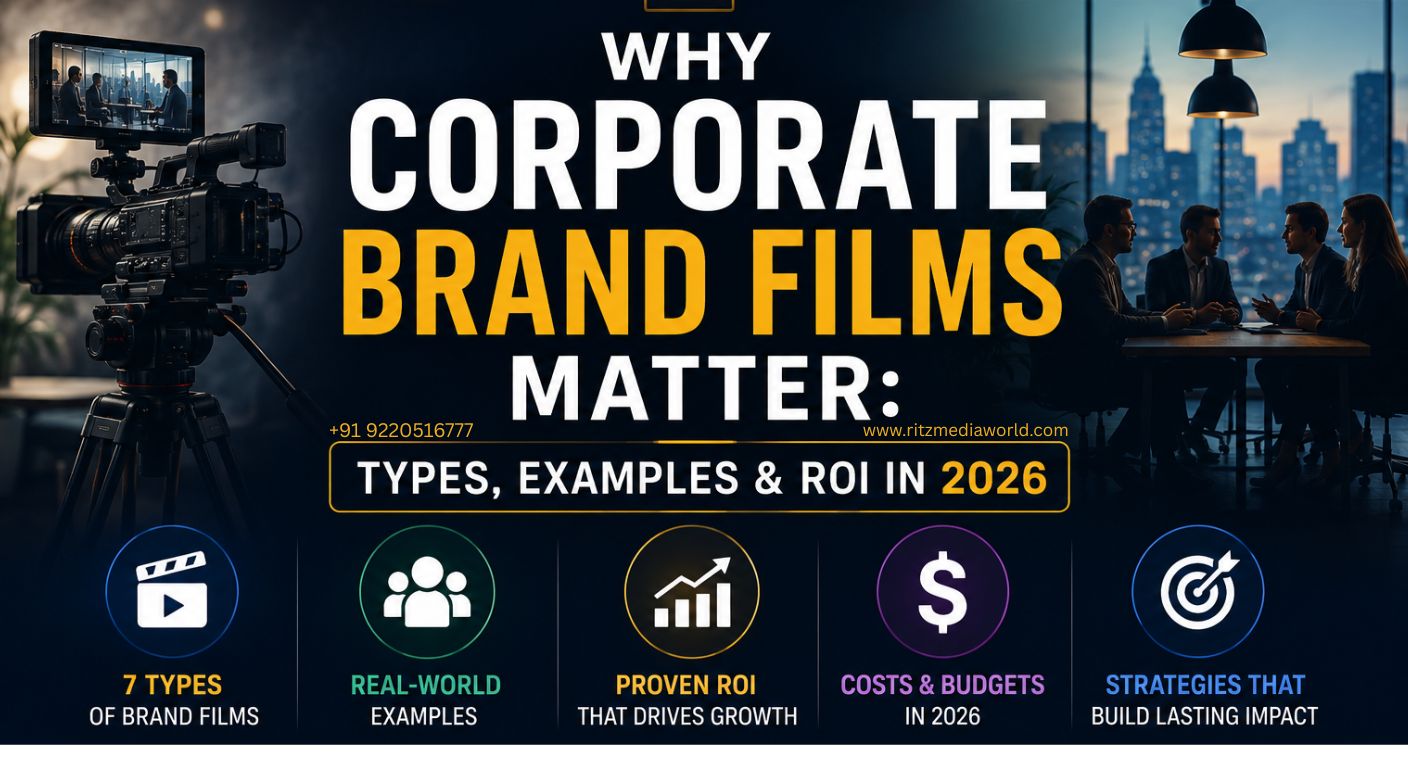
This piece covers everything: what corporate brand films actually are, the seven types and when to use each, why they work, how production actually unfolds, what they cost in 2026, and where the format is heading. If you're a brand manager, a founder, or someone who's been staring at a production quote wondering if this is worth it, read this before you decide.
To see how storytelling, branding, and video production come together to drive business growth, explore our Digital Marketing services and discover solutions tailored to modern brands.
What Are Corporate Brand Films?
A corporate brand film is a professionally produced video built around one job: communicating who a company is, not just what it sells.
Most brands get this wrong, and it costs them. An ad is trying to close something. A brand film is trying to open something, a feeling, a preference, a quiet sense of trust that builds before the sales conversation even begins. The product might not show up in the frame at all. What will always show up is a point of view.
Unlike the stuff that gets produced out of obligation, the compliance training video, the annual report voiceover nobody actually watches, brand films have a shape. There's a beginning. Something's at stake in the middle. And by the end, something shifts, in the story, and in how you feel about the company telling it.
They use real people, real locations, real stakes. A
well-made brand film does something a LinkedIn post or a homepage
paragraph will never do, it makes you feel like you already know this company.
That's the whole point.
7 Types of Corporate Brand Films
Not every brand film is trying to do the same thing. Here are the seven formats that actually move the needle, and what each one is built for.
1. Brand Anthem / Identity Film
This is the foundational one. It answers the most important question a brand can answer: who are you, at your core? Not what you sell, not your founding year, not your client list. Your why. Brand anthems live on website homepages, open conferences, anchor investor decks. They're not product-specific. They're philosophy-specific, a cinematic version of the reason your company exists.
2. Culture & Employer Branding Film
Built for recruitment and retention, though they do double duty as internal pride pieces. A well-made culture film doesn't say "we have a great team", it shows what a Tuesday actually looks like inside your office. In Noida's competitive talent market, where candidates are fielding three offers at a time, a film that makes them feel something about your company before the interview can completely change who walks through the door.
3. Customer Testimonial Film
Not the two-minute talking head with a logo slapped behind someone's head. A proper testimonial film follows someone through the whole arc, where they were stuck, what made them take the leap, and what actually changed on the other side. Shot documentary-style, it earns its credibility instead of performing it. The viewer believes it because it doesn't feel like it was written in a boardroom.
4. Product/Service Film
This one walks the line between brand and marketing. The ones that work don't open with a spec sheet. They open with a person who has a problem, and then let the product arrive as the answer. By the time it shows up on screen, you're already rooting for it. USPs land harder that way because you've already felt the need.
5. Founder / Leadership Story Film
People buy from people. This format humanizes the face behind the brand, the origin, the convictions, the specific obsessions that made someone build what they built. Founders who've done these consistently say it changes the quality of inbound conversations. Prospects arrive already warmed up, already feeling like they know you. That's not marketing. That's relationship-building at scale.
6. CSR / Sustainability Film
If your brand is built around a deeper purpose, your content has to carry that weight too. A CSR film that actually works isn't a press release with a camera, it's evidence. It shows the mud on the boots. The community meetings that ran two hours over. The commitment that cost something. That's what makes people believe you mean it, rather than just saying it in your about page.
7. Event & Conference Film
Most event films are glorified highlight reels, drone shot of the venue, clapping hands, CEO at a podium. The good ones capture what actually made the event worth attending: the energy in the room, the corridor conversations, the moment an idea landed visibly on someone's face. Circulated to stakeholders’ post-event, these become serious trust signals. They say: this company convenes serious people around serious ideas. Come next year.
Which Film Type Fits Your Goal?
|
Goal |
Best Format |
|
Build brand awareness |
Brand Anthem |
|
Attract top talent |
Culture Film |
|
Drive sales conversations |
Customer Testimonial |
|
Launch a product |
Product/Service Film |
|
Build founder credibility |
Leadership Story |
|
Demonstrate social impact |
CSR Film |
|
Amplify an event's reach |
Event Film |
Why Corporate Brand Films Actually Work
I'll be straight with you, when I first started pushing brand films to clients, some pushed back hard. "Isn't this just expensive content that looks pretty and doesn't convert?" It's a fair question. I've heard it sitting across the table in Sector 18 boardrooms. Here's the honest answer.
The emotional math is real. A person who watches your brand film for three minutes has spent more meaningful time with your company than someone who scrolled past fifty of your posts. That time creates something. Not immediately, but it accumulates. And when the moment comes to make a decision, brands with emotional presence win.
Search engines notice. Websites with video hold visitors longer, reduce bounce rate, and signal to Google that the page is worth surfacing. That's not speculation, it shows up in rankings. A brand film on your homepage earns SEO value every single day it sits there.
Memory works differently with video. People who watch your brand film can recall it weeks later, sometimes months. Ask them to recall a blog post they read last Tuesday and you'll get a blank stare. The format itself creates retention in a way that text simply doesn't.
One production, dozens of uses. Website hero. Conference opener. LinkedIn video. Sales deck attachment. Investor presentation. Onboarding resource. A well-made brand film doesn't live in one place, it travels. That production cost gets amortized across every room it walks into.
The ROI data isn't new anymore. 93% of marketers report that video delivers strong ROI, and yet budget hesitation is still the number one reason companies delay. That gap between what the evidence says and what finance teams approve is exactly where opportunity lives. Brands that commit now are quietly lapping competitors who are still "evaluating."
The Corporate Brand Film Production Process
Production looks intimidating from the outside. It isn't, if you understand the shape of it. Here's what actually happens.
Step 1: Discovery & Brief
Before a single camera gets picked up, you need to know three things: what the film is trying to achieve, who it's talking to, and what the one thing is that someone should feel after watching. A vague brief produces a vague film. I've seen brands spend two weeks in this stage, and I've seen it save months in post. Spend real time here. It's not overhead. It's the whole foundation.
Step 2: Pre-Production
Script development, storyboarding, casting, location scouting, shoot scheduling. This is where most of the actual work happens, even though nobody sees it. A production that looks effortless on screen is usually the result of obsessive preparation before the shoot day. Surprises at the brief stage cost nothing. Surprises on a live set with a full crew cost everything.
Step 3: Production
This is shoot day, camera work, lighting, direction, and sound, all handled by a crew that knows how to capture real moments and make subjects feel comfortable enough to be genuine. The gap between a good crew and a mediocre one is visible in the first five seconds of any film. It's in the eyes. It's in whether the person on camera looks like they're performing or actually talking.
Step 4: Post-Production
Editing, colour grading, audio balancing, sound design, motion graphics, music. This is where footage becomes film. A strong editor doesn't just assemble scenes, they find the story inside the material, cut the things that dilute it, and build the emotional rhythm from scratch. Done well, this phase turns a good shoot into something that gives people goosebumps.
Step 5: Distribution
A finished film without a distribution plan is a tree falling in an empty forest. Build the deployment strategy before the shoot wraps: website embed, YouTube upload, LinkedIn native video, sales team enablement kit, event screening plan. The film's reach is entirely a function of how intentionally you send it into the world.
How Much Does a Corporate Brand Film Cost?
Everyone asks this question. Nobody wants to answer it directly. I'll try.
We get asked about pricing in almost every first conversation, which is fair, because "it depends" is an annoying non-answer.
Here's what we can tell you. Internationally, basic corporate video runs $3,000–$10,000 per finished minute in 2026. For cinematic brand films, where you're bringing in a director with a real vision, scouting locations, commissioning original music, and doing colour grading that actually shapes the mood of the film, that range stops applying pretty quickly.
In the Indian market, mid-range brand productions typically fall between ₹3 lakh and ₹8 lakh. Where exactly within that range depends on crew size, number of shoot locations, and how much of the scope is figured out before we start. Premium work, the kind we'd put next to anything produced internationally, starts at ₹10 lakh. Some projects go well beyond that, and for good reason.
What makes a budget climb: multiple locations, drone work, animation, original compositions, short turnarounds, and brief changes that arrive after production has already started. What keeps things efficient: a clear objective from day one, one primary location, quick internal approvals, and a client who trusts the process.
The framing that actually helps is this: a brand film isn't a production expense. It's a sales asset with a shelf life of two to three years. Divide the production cost by the number of times it shows up in a pitch deck, a website session, a conference, a hiring conversation, a press feature. The per-impression cost gets very small, very fast. Most clients who've done it once come back to do it again within eighteen months.
Corporate Brand Film Trends in 2026
The format is moving fast. Here's what's actually happening.
Cinematic quality is now the floor, not the ceiling. The slow-paced, executive-talking-to-camera format is functionally dead. What's replacing it are story-driven productions with aerial footage, original scores, and narratives that make people feel something before they've even processed what industry they're watching. Brands still producing content that looks like it was shot in 2017 are visibly behind, and their audiences know it, even if they can't articulate why.
Documentary-style brand films are having a real moment. As AI-generated content floods every channel, competent, cheap, instantly forgettable — branded documentaries are emerging as the direct antidote. They're harder to fake. They require actual access, actual stories, actual craft. That difficulty is precisely what makes them credible. You can't prompt-engineer a real relationship between a brand and its community.
Vertical formats are now a production requirement, not an afterthought. Shooting for LinkedIn Reels, Instagram, and YouTube Shorts isn't a separate line item anymore, it's built into every production from the first planning call. The 16:9 master file is for the website. The 9:16 cut is for where people actually spend time.
Behind-the-scenes is becoming the content itself. Audiences, especially younger decision-makers, trust the process more than the polished result. Watching something get made is its own story. Brands that capture the making-of deliberately, rather than as a social afterthought, are finding that the raw footage often outperforms the film it was shot to support.
AI is compressing post-production timelines. The smarter agencies are using AI tools for transcription, rough cut assembly, and audio cleanup, not to replace editors, but to get them to the creative work faster. For clients, this translates to quicker turnarounds and more of the budget going toward what's actually on screen.
Frequently Asked Questions
Q: What is the difference between a corporate film and a brand film?
Ans- Okay so this one trip people up all the time, and honestly the line is blurrier than most definitions admit. A corporate film is really just an umbrella term, it covers anything a business produces on video, from a safety training module to a product launch. A brand film is a specific thing inside that umbrella, and what makes it specific is intent. It's not trying to explain something or sell something directly. It's trying to make you feel something about who the company is. The values, the culture, the reason the business exists at all. A brand film might not mention a single product or service anywhere in its runtime, and that's completely intentional.
Q: How long should a corporate brand film be?
Ans- Genuinely depends on what the film is trying to do, but if you want working numbers, brand overview films tend to hold attention best at the 2–3 minute mark, and product explainers work at 60–90 seconds. What actually matters more than length is whether every single second is earning its place. Most first drafts are thirty to forty seconds too long, and those extra seconds are where viewers quietly check out. The edit that hurts to make is usually the right one.
Q: Do corporate brand films help with SEO?
Ans- Yes, and it works through behaviour, not magic. When someone lands on your website and watches a three-minute film, they stay on the page longer. They don't immediately bounce. Google reads those engagement signals and interprets them as evidence that your page is genuinely useful. Do it properly, host on YouTube, embed on site, add a transcript, file a video sitemap, and the organic benefit compounds over time.
Q: Which brands make the best corporate films?
Ans- Globally, Apple, Nike, Patagonia, and Dove get cited constantly, and for good reason. Each of them figured out how to make films that feel like cultural artifacts rather than branded content. In India, Tata, HDFC, and Asian Paints have produced work that holds up against those benchmarks. The thread connecting all of them is the same: a clear point of view, a real story underneath it, and the craft to execute both without flinching.
Ritz Media World has been producing corporate brand films for companies across Delhi NCR and pan-India for over 17 years. If you're thinking about your next brand film, or trying to figure out whether it's the right move for where your brand is right now, we're easy to reach.
For the best advertisement rates, Contact us :-
9220516777
info@ritzmediaworld.com
402-404, 4th Floor Corporate Park, Tower A1 Sector 142, Noida, Uttar Pradesh, India