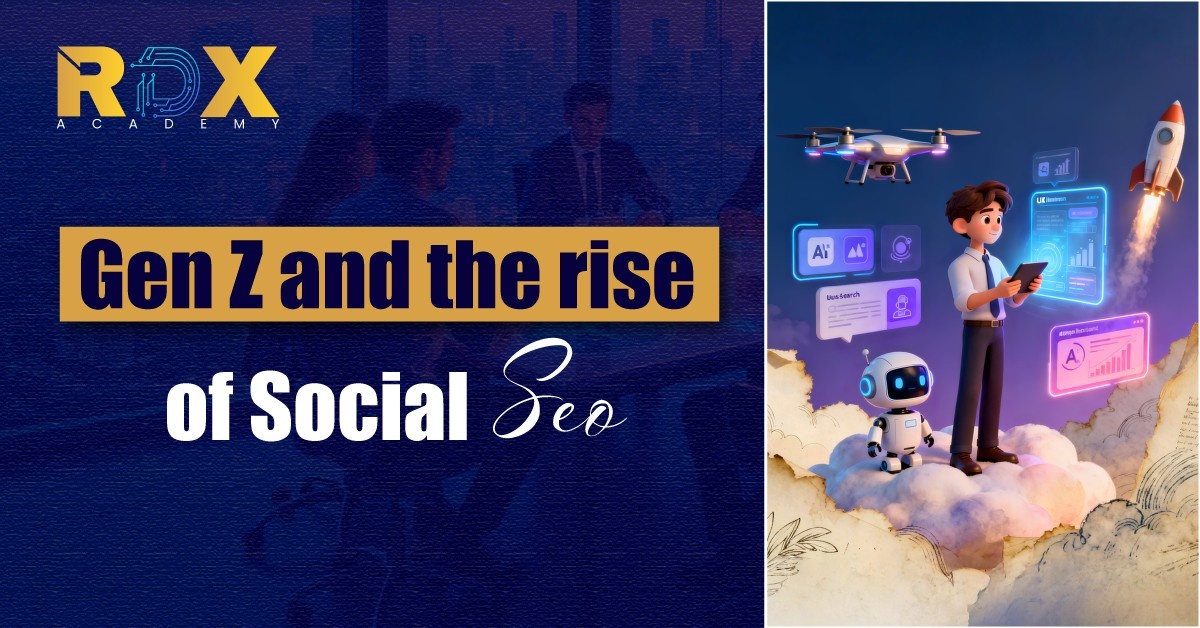
If you want to hide something from Gen Z, put it on page one of Google.
That is a mild exaggeration, but only mild.
For an entire generation, the starting point of curiosity is no longer a blank white search box. It is a feed. When they want to know where to eat, what to wear, which laptop to buy or whether a neighbourhood feels safe, they are far more likely to start on Instagram, TikTok or YouTube than on a traditional search engine.
Multiple studies now suggest that roughly 40 to 50 per cent of Gen Z prefer social platforms over search engines as their first stop for information and brand discovery, and that figure rises further when you look at products and lifestyle decisions. Google’s own leadership has admitted that in some use cases, such as finding a place for lunch, nearly 40 per cent of young users simply bypass Google Search and Maps in favour of TikTok and Instagram.
For marketers, this is not an amusing generational quirk. This is a thorough rearrangement of the shop window.
We are living through the rise of what people have started calling “social SEO”. I would argue it is less a new discipline and more a quiet return of something advertising has always done well: understanding how people really look for reassurance, proof and delight, and then being findable in those places.
When the search moved from the library to the cafe
Traditional search is, in spirit, a library.
You walk up to the desk, mutter your query in the hope you have phrased it correctly, and are rewarded with a stern list of results in descending order of relevance as judged by a mathematically gifted librarian.
Social search is more like walking into a lively cafe and asking the room.
You do not want a list of official documents. You want to know where people like you actually go, what they actually bought, and how it actually felt. You want stories, examples, and visual proof that other human beings have survived the decision without regret.
It is hardly surprising that a generation raised in a constant flow of video, reaction and commentary would prefer the cafe to the library.
Research from eMarketer and others shows that nearly half of Gen Z now say they prefer social media over traditional search engines when looking for information, and that a similar proportion discover new brands almost daily inside social feeds. Separate studies suggest that for brand and product research, more than 70 per cent of Gen Z are happier starting on social platforms than with a conventional search engine.
If you are a brand that is exquisitely visible on Google and practically invisible inside those feeds, you have optimised beautifully for yesterday.
What “social SEO” really is
Because marketing loves a buzzword, “social SEO” has already picked up the usual barnacles of confusion.
It is not:
- Stuffing more hashtags into your captions
- Dropping a few keywords into a Reel description
- Posting the same asset on five platforms and declaring victory
A useful working definition is this:
Social SEO is the art of making your content easily discoverable in the ways people actually search inside social platforms.
That means:
- Using the language real people use in titles, hooks and captions
- Structuring videos so that the “answer” is clear in the first few seconds
- Organising your content around question clusters, not campaign calendars
- Earning the engagement signals that social algorithms treat as “relevance”: watch time, saves, shares, comments
Traditional SEO tries to convince a machine that your web page is the best answer. Social SEO tries to give a human being such a satisfying experience that the machine notices and brings you more humans.
The currency has changed. Backlinks are replaced by watch time and saves. Meta descriptions are replaced by hooks, thumbnails, and that slightly mysterious thing called “vibe”.
How Gen Z actually searches
To see why this matters, it is worth imagining the same query executed in two different worlds.
Take a simple example: “best areas to rent in Pune as a young professional”.
Typed into Google, this yields a long list of blogs, listicles, occasionally helpful portals and a forest of ads. If you are diligent, you may eventually arrive at something resembling insight.
Typed into Instagram or TikTok, the same intent might surface:
- A reel from someone who has just moved and is ranting entertainingly
- A creator who specialises in city guides with colourful maps and rent overlays
- Short clips titled “3 areas I regret not considering” or “Places your broker will never show you”
- Comments underneath where people argue vehemently about noise, safety and landlords
The second experience is messier, more anecdotal and, from a purely rational point of view, possibly less “authoritative”.
Yet for Gen Z, it often feels closer to the truth, because it is anchored in visible human experience. It is an X-ray of what it might feel like to live there, not just a description.
That is what they are optimising for. Not mere accuracy, but empathic accuracy. Not “what is the answer”, but “what will this choice feel like for someone like me”.
Once you see that, social SEO stops being a marginal technical concern and becomes central to how your brand offers reassurance.
The unseen ranking signals of social platforms
On Google, ranking signals are discussed almost obsessively in public. On social platforms, they are not, although they exist all the same.
Consider the silent questions a platform asks when a user types a query into its internal search bar:
- Which pieces of content for this query lead to longer viewing sessions
- Which accounts consistently produce satisfying content on this topic
- Which videos get saved and shared, not just started
- Which ones attract comments that suggest “this was genuinely useful” rather than just “nice” or a fire emoji
From those signals, it gradually learns that certain accounts are good bets whenever a user expresses a particular intent.
In other words, it builds topic authority maps, just as search engines do.
If you regularly publish clear, engaging content around “moving to Gurugram from another city”, and viewers watch it to the end, save it, comment with thanks and share it with suffering friends, you have quietly become part of the platform’s internal answer sheet for that topic.
You will never be given an official ranking report. Instead, you will be given something more valuable: organic distribution to an ever-larger circle of people with that intent.
That is social SEO working, whether or not you call it that.
Why is this good news for smaller brands
There is a tendency to assume that any new algorithmic frontier will inevitably favour the largest players.
In this case, the opposite can often be true.
A huge legacy brand, steeped in compliance, global guidelines and a robust fear of controversy, will struggle to produce the kind of specific, honest, occasionally untidy content that performs well in social search.
It is very hard to answer a question like “how do I know if this builder is trustworthy” with any useful candour when an army of lawyers is reading over your shoulder.
A smaller brand, or a founder not yet entirely house-trained, can simply switch on the camera and say:
“Here are three checks you should always do. One of them might make you decide not to buy from us. That is still a better outcome than a lifelong grudge.”
Gen Z has a well-developed nose for this kind of honesty. Research suggests that more than 70 per cent of them prefer to research brands and products on social media, and a similar majority have discovered products through organic videos in their feed.
In a world where social platforms act as both search engine and television network, the nimble, interesting, slightly imperfect advertiser can steal a great deal of contextual attention from the big, glossy but interchangeable one.
Social SEO, in that sense, is a re-democratisation of visibility. You cannot buy your way to the top of a results page quite as crudely. You have to earn an invitation to stay on screen.
How to think like a social search brand
If you run a business, particularly one that sells considered purchases such as homes, education, financial products or B2B services, how do you respond to this shift without losing your mind or your dignity?
A few principles help.
1. Start with the questions, not with the brand messages
Most brand content still begins life in a boardroom, with sentences like “We need to communicate that we stand for X”.
In a social SEO world, a more fruitful starting point is:
“What would someone actually type into a search bar, on a bad day, about our category?”
Those queries will not be pretty. They will sound like:
- “Is [location] safe for women at night?”
- “Is it dumb to buy a house before 30?”
- “Real estate scams to avoid in Goa”
- “What happens if my builder goes bankrupt?”
If your content answers those questions in plain language, on the platforms where they are actually asked, you have earned far more than brand awareness. You have earned the beginnings of trust.
2. Optimise for clarity, not for mystique
There is a peculiar modern aesthetic that values cryptic, minimal posts with almost no text. They look wonderful in awards entries. They are utterly useless for search.
In social SEO, clarity is kindness.
That means:
- Saying the topic in the first line of the caption
- Saying the key phrase aloud in the video
- Using unglamorous but accurate words in titles
- Letting thumbnails and covers show, not hint
If the algorithm and the viewer cannot tell at a glance what you are about, they will politely move on to someone who can.
3. Build topic authority, not random virality
Going viral is the marketing equivalent of winning the lottery. It is delightful when it happens, unreliable as a business model.
A better goal is becoming quietly unavoidable on a handful of topics.
Pick three to five clusters where you want to be the default answer. For a real estate brand, for instance:
- “First-time home buying in [city]”
- “Decoding under-construction vs ready-to-move”
- “Understanding neighbourhoods in [region]”
- “Investment vs end-use decisions in property”
Then make dozens of pieces of content around each cluster, in varying depths and formats.
From the platform’s point of view, you are steadily raising your hand every time someone hints at that intent. Over time, you become an easy account to bet on whenever that query appears.
4. Use people as your landing pages
Gen Z does not really want to talk to “a brand”. They want to hear from someone recognisable who seems to know what they are talking about.
This is where founders, senior practitioners, on-ground experts and even well-briefed salespeople become strategically important.
They are your living landing pages.
When they consistently show up in content, answering specific questions with humour, humility and some degree of opinion, they do three things a static web page cannot:
- Convey a sense of competence and personality in under 30 seconds
- Make the brand feel socially real rather than abstract
- Attract searchers who are looking for “someone like this”, not just “information”
Of course, this makes legal teams nervous. That is healthy. Advertising has always been a dance between what we would like to say and what we dare to say. The trick is to have the conversation, not to retreat into silence.
This is not the death of Google. It is the end of laziness.
It would be easy to take all this as a cue to proclaim that “SEO is dead” and that all search will be social from now on. Reality, as usual, is messier.
Google is not going away. It is evolving, incorporating more social and video, and experimenting with its own forms of conversational and generative search.
Even the much-quoted statistic that “40 per cent of young people use TikTok or Instagram instead of Google” has been critiqued as oversimplified. Human beings do not behave consistently. Sometimes they want the library, sometimes the cafe.
The important point is not that one has replaced the other, but that brands can no longer rely on being found in only one of those places.
In the past, you could get away with a half-decent website, some keyword stuffing and a few backlinks. You would probably appear somewhere respectable when someone went looking.
In a world where search is partly a social, visual and emotional act, laziness is punished more swiftly.
You are expected to be:
- Findable in the places where curiosity now begins
- Legible in the language people genuinely use
- Watchable and listenable enough to justify a few more seconds of attention
In other words, brands are being nudged back towards what they were meant to be all along: interesting and useful.
A final thought: social SEO as applied to common sense
From one angle, “Gen Z and the rise of social SEO” sounds like a profound technical shift.
From another, more Sutherland-ish angle, it is simply the latest reminder that human beings have always preferred to ask people they feel they know, in places they feel at home, for advice they feel is honest.
The only real difference is that “people they feel they know” are now creators and quasi-strangers on video. “Places they feel at home” are social platforms. And “advice they feel is honest” is reinforced or shredded in the comments underneath.
Our task, as brands and as marketers, is not to fight this. It is to learn how to participate in it gracefully.
That means thinking less like engineers of funnels and more like hosts at a very large, very talkative gathering.
It's easy to find. Be clear. Be occasionally surprising, rarely boring and only as self-promotional as the context allows.
If we do that well, we may find that social SEO is not a frightening new discipline at all. It is just good advertising, forced to be honest slightly earlier in the process.