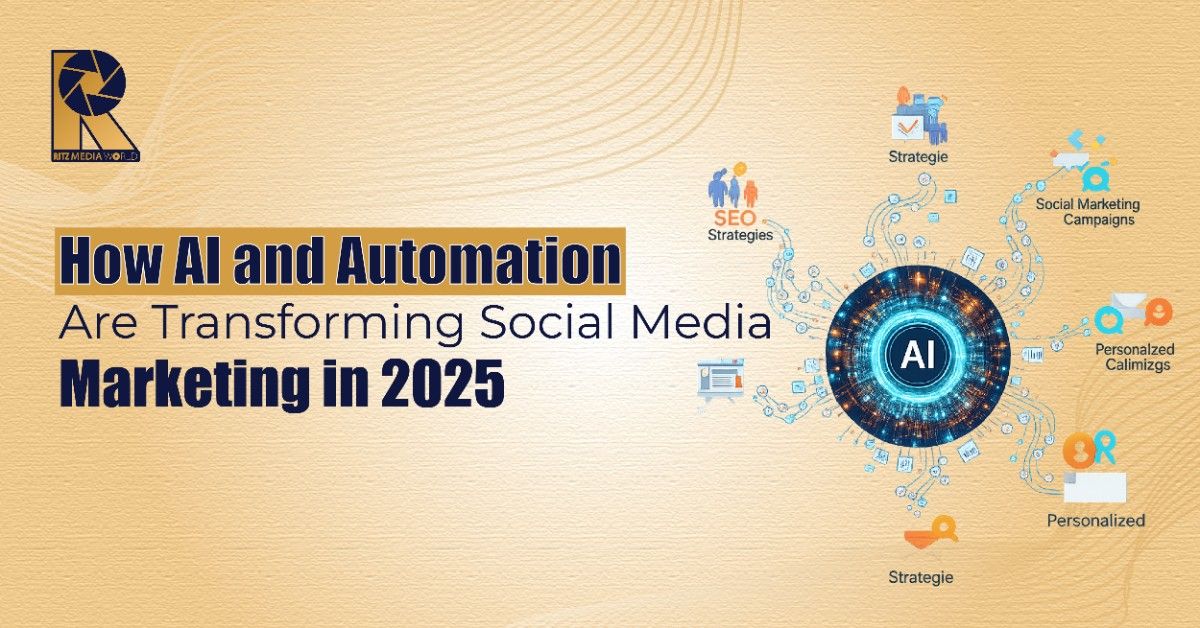
In the ever-changing landscape of social media, it is always difficult to remain relevant. It requires a new content, real-time optimization of campaigns, and immediate and tailored interaction with the customers. This is where artificial intelligence (AI) and marketing automation have not only become a fantasy of the future, but the new engine that will power contemporary social media marketing. Doing repetitive work and deriving meaningful data-driven insights, AI is making marketers smarter, more creative, and efficient than ever before.
The power of AI in boosting your social media
By enhancing each level of marketing, AI is fundamentally altering how brands engage with and perceive their viewers by improving the interaction between themselves and the audience.
1. Relevant content development
- Idea generation - AI system can monitor trending topics and user discussions, as well as successful competitor posts to generate new ideas to be used in posts.
- Copywriting - AI writing assistants are able to generate captions, headlines and ad copy to fit the various platforms and target audiences, in your brand voice.
- Visuals - Generative AI can generate images, videos and graphics within a few seconds, or transform long-form content into platform-specific visual snippets.
2. Hyper-personalization and targeting
- Audience Segmentation - AI algorithms are used to analyse the behaviour, interests, and demographics of the audience to produce very specific audience segments. It is possible to deliver personalized content and advertisements that appeal to the user at a personal level.
- Dynamic advertising - AI-powered platforms such as Meta and Google have the ability to process ad campaigns in real-time by bidding and directing them automatically, to maximize return on investment (ROI).
3. Predictive analytics and real-time
- Social listening - A comprehensive AI system has the ability to track brand mentions and conversations on the web to determine audience sentiment in real-time. This serves as an early warning system of the PR crisis and aids brands to narrow down their message.
- Performance forecasting - AI can be applied to predict the success of a campaign with the help of historical and real-time data to forecast future trends. This gives marketers permission to make proactive decisions that are based on data instead of responding to previous performance.
4. Intelligent customer interaction
- 24/7 chatbots - Chatbots and virtual assistants, powered by AI, may offer real-time assistance to customers, respond to commonly accepted questions, and direct users through the sales funnel.
- Intelligent responses - AI will be able to auto-respond to social media posts and messages with relevant and empathetic replies, so that you always engage with your community in a consistent and timely manner.
Automation - The workhorse of efficiency
The heavy lifting is taken care of by automation, whereas the intelligence is offered by AI. The automation tools automate repetitive issues and your team is then free to concentrate on high value strategic activities.
1. Scheduling and publishing - Artificial intelligence (AI) tools such as Buffer and Hootsuite collect audience data to post automatically during the most successful times to reach the greatest number of people and connect with them.
2. Content curation - Auto-curation could supply and suggest pertinent third-party content to keep your social media feed continually updated.
3. Reporting - Automated reporting will be able to produce real-time insights and performance indicators and will not require manual data collection.
The moral issues and dilemmas
With such tremendous benefits, there are enormous responsibilities associated with the emergence of AI and automation in marketing.
- Data privacy - Due to the fact that AI needs massive quantities of user data, there is a possibility of privacy breach. Companies should be open regarding the information gathering and follow the rules such as GDPR to promote and preserve trust.
- Algorithmic bias - When AI models are trained on biased data, they may reproduce and guide the existing biases in the society, which results in unfair or discriminative effects in targeting and content.
- Loss of human touch - When automation is overused it will result in impersonal methods of interaction and may worsen customer relations. The trick is to introduce AI to enhance, not substitute, true human contact.
- The Black Box problem - It is not a straightforward decision to understand the complex decision-making process of certain AI systems, which leads to accountability and transparency concerns.
The hybrid approach is the future
Social media marketing does not exist as a human or AI-driven phenomenon only; it is a potent combination of the two. Through AI and its ability to automate repetitive behaviors, marketers can invest in the creative, strategic, and human aspects of their work. The brands that will thrive will be those that masterfully negotiate the ethical terrain, leverage AI to enhance their gut feeling, and bear in mind that technology is a means of developing more meaningful relationships with individuals.
FAQs
Q1 Is AI marketing
ethical?
The application of AI in marketing can be ethical when it is transparent, data safe, and user approved. Ethical issues are associated with AI interfering with emotions or gathering information without consent. Honesty, fairness, and privacy are the primary traits that marketers should consider in any AI-based campaign.
Q2 What is the best AI to use in marketing?
ChatGPT, Jasper AI, HubSpot, Hootsuite Insights, and Adobe Sensei are some of the most useful AI tools used in marketing. The platforms are useful in the creation of content, audience targeting, analytics and automation- making campaigns more efficient and customized.
Q3 What are the difficulties of applying AI to digital marketing?
The most notable challenges are issues of privacy of data, high implementation cost, and loss of human creativity. Also, AI-based models have a risk of biased decisions when being trained with faulty data, which affects brand trust and credibility.
Q4 What is the demerit of AI in media?
AI may occasionally cause false information, deepfakes, and lead to the loss of human labour in production processes of media. The excessive use of automation can also result in less original, less engaging content that is not emotionally related to audiences.
Q5 What is the AI trend in marketing in 2025?
Over the next five years, the field of AI marketing revolves around hyper-personalization, predictive analytics, and voice search optimization. AI will help the brands to predict the needs of customers, automate interactions, and provide very targeted content on all digital platforms.