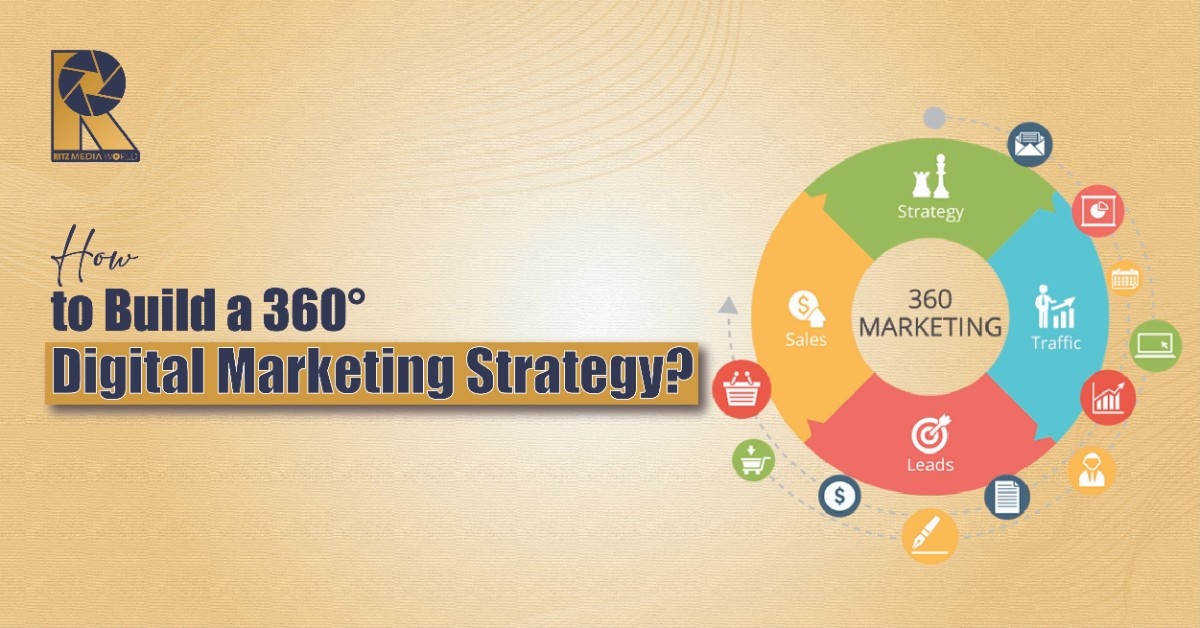
A brand cannot depend on just one platform or one manner of marketing in the rapidly changing digital world of today. Customers have access to brands via social media, websites, search engines, emails, mobile apps, and even offline events. In order to reach them effectively, businesses need a 360 Digital Marketing Strategy that provides a seamless and consistent brand experience across all interaction points. Such an approach guarantees that your communication will be delivered to the target audience, at the right moment, and with the appropriate content.
A Digital Marketing Strategy does not only imply the presence of a company on various platforms. Rather, it involves the establishment of an integrated branding, messaging, communication, and performance measurement system. Most importantly, it shows how these marketing tools are interwoven to achieve one ultimate goal of the organization - trust acquisition and conversion increase.
Why a Full-Funnel Approach Matters
The first and foremost point a Full Funnel Marketing Strategy should be built on is the recognition of the customer's decision-making process. Most stages from Awareness to Interest, Consideration, and finally Purchase, all require different communication styles and platforms.
- Top of the Funnel (Awareness): Social media campaigns, influencer promotions, blogs, and brand storytelling provide the means to acquaint the brand with the target audience.
- Middle of the Funnel (Consideration): Email marketing, case studies, retargeting ads, and comparison content are some of the ways through which brands can gain the audience's trust.
- Bottom of the Funnel (Conversion): Personalized offers, testimonials, free trials, and compelling calls-to-action prompt users to complete their purchase journey.
Their systematic pilgrimage makes sure that every lead is nurtured and pushed towards conversion.
Steps to Build a 360° Digital Marketing Strategy
To establish a working and long-lasting Digital Marketing Strategy, brands should follow a defined timeline:
1. Understand Your Target Audience
Knowing your audience is the foundation of a successful campaign. Determine the demographics, interests, needs, and challenges of your target audience, as well as their online habits. The more detailed your customer persona is, the more effective your communication will be.
2. Craft a Strong Brand Identity
Your brand must have a distinct voice, style, and message. Whether one comes across your reel, website banner, or billboard, it should be obvious at one glance that it is yours. The branding consistency is the basis of an Integrated Marketing Strategy.
3. Choose the Right Digital Channels
Every platform is not suitable for every business. For example:
- Instagram and YouTube work great for visual storytelling.
- Google Ads is an excellent tool for intent-based targeting.
- Email marketing is beneficial for building customer relationships that last for years.
Decide on the channels where your target audience is the most active and tailor your content for that medium.
4. Develop High-Value Content
Content being the pillar of digital marketing, it is imperative to ensure that content pieces of all lengths and types, be they social posts, long-form articles, landing pages, videos, or anything else, serve one or more of these purposes - educate, engage, convert. Genuine and well-produced content opens the path to gaining authority and trust.
5. Run Performance-Based Campaigns
Put paid advertising to good use. Retarget those users who have visited your website or social media channels. Segment your ad campaigns according to the users' behaviour, interests, or purchase stage.
6. Track, Measure, and Optimize
Use instruments such as Google Analytics, Meta Ads Manager, and CRM dashboards to measure success. Do more of what works and less of what doesn't.
Final Thoughts
A 360 Digital Marketing Strategy is not a single-motion attempt but rather a continuous cycle of steps planning, execution, analysis, and refinement. The results of a brand combining strong identity, full-funnel campaigns, and optimized multi-platform execution are increased visibility, better engagement, and long-term customer loyalty.
In essence, the integration and consistency of your approach will be directly proportional to the strength of your digital presence.
FAQs on Building a 360° Digital Marketing Strategy
1. How is a 360° digital marketing strategy different from usual marketing?
Typically, a regular marketing strategy concentrates on one or two channels at a time. On the other hand, a 360° digital marketing strategy leverages all the possible customer-facing channels, e.g., social media, SEO, email, paid ads, website, and CRM to maintain the same communication and create a seamless experience for the customer.
2. Is a 360 digital marketing strategy a big company thing?
Definitely not. Even small and medium business communities can implement a Full Funnel Marketing Strategy by simply picking a few platforms where their audience is most active. Though the scale may vary, the power of the integrated approach stays intact.
3. How long does it take to see the fruits of a 360° marketing approach?
The timeframe is goal and industry-dependent and thus not always the case. However, as a rule of thumb, brands who are consistent in their content, branding, and strategy of their campaign start seeing measurable results within 8 - 12 weeks.
4. What are the must-have digital platforms for a 360° strategy?
There isn't a universal answer that fits all cases. Nevertheless, the majority of businesses achieve optimal results by combining the following:
The choice of your audience reveals the priority of platforms.
5. Do I need a complete team to handle a 360° strategy?
Not necessarily. You can initially have a small internal team that is supported by freelancers or an agency if you have a budget limit. What matters the most is coordination and consistency rather than the size of the team.
6. In what ways does branding impact a 360 digital marketing strategy?
Branding is responsible for the tone, the look, the message, and the feeling that the marketing campaigns evoke. Without a well-established brand, even a multi-channel approach will be perceived as uncoordinated and less effective.
7. Are automation tools effective in implementing a 360° strategy?
Absolutely. Automation tools such as HubSpot, Mailchimp, Meta Business Suite, and Google Analytics facilitate the process by automating emails, tracking customer behaviour, scheduling posts.