If you ask most people why they bought a home, they will say something improbably rational: schools, commute, square footage, “investment.” If you watch what happens, you’ll see something different. A micro-drama unfolds. Someone falls in love with a kitchen island. A hallway feels cinematic. The place “just clicks.” Your job in real-estate marketing is not to win a spreadsheet duel; it’s to orchestrate that click.
Two pieces of kit make the click more likely: anamorphic visuals (the cinematic look or 3D illusion that stops the scroll) and walk-throughs (video or interactive tours that let buyers mentally move in). One seduces; the other reassures. One is the peacock feather; the other is the guided tour after the plumage has worked. Deployed together, they change what it feels like to buy, where most of the value lives.
Anamorphic: Champagne for the Eyeballs
Attention is the rarest currency online. Anamorphic footage buys it at wholesale. The wide aspect ratio, creamy depth, and tasteful flares are not merely “pretty.” They perform a vital piece of psychology: costly signalling. When something looks as if care and expense have been lavished upon it, we unconsciously assume the underlying asset is valuable. (Peacocks don’t grow feathers for aerodynamics.)
There’s also the price–quality heuristic at work. When the marketing looks premium, the property inherits the glow. In a category where listings blur into rectangular sameness, white walls, recessed lights, and a stainless-steel appliance smirking at you, distinctive visual language becomes an asset. Those horizontal flares and letterbox frames act like a brand’s jingle for the eyes. They create distinctive memory structures: the things your brain can retrieve later when it’s comparing ten almost-identical options.
And let’s be honest: widescreen compositions dramatize space. They don’t lie; they stage. Good staging is not deception, no more than dressing smartly for a job interview is deceit. It’s the art of letting the best bits speak in a dialect your audience understands: emotion first, detail second.
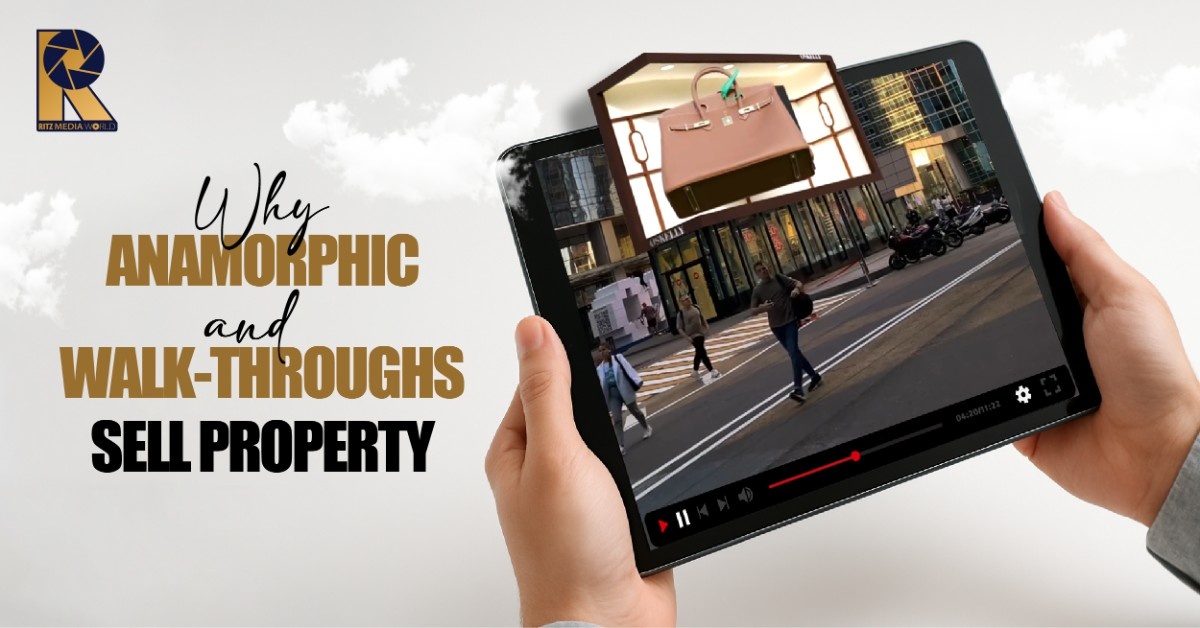
“Ah,” someone will say, “but what about 3D anamorphic illusions, the pop-out billboards and perspective tricks?” Used sparingly, they’re accelerants. They generate talk value and earn reach. If your flagship development can momentarily escape the rectangle and ambush a passerby’s Instagram feed, you’ve bought attention you didn’t have to rent from an ad platform. Crucially, illusions imply ingenuity. Buyers don’t just buy square feet; they buy the competence of the people behind them. An unexpected visual trick says: we think harder.
A caveat: do keep the gimmick in servitude to meaning. The goal is not “lens flare per minute.” It’s: do my visuals make the big ideas (light, flow, outlook, neighbourhood) feel inevitable?
Walk-Throughs: Reducing the Cognitive Gym Membership
If anamorphic is Champagne, the walk-through is water. Lovely, necessary, and oddly rare in sufficient quantity. The barrier to property purchase is not only money; it’s imagination tax. Most people are terrible at mentally simulating routes, sightlines, and the choreography of daily life. Static photos outsource nothing from that tax; a walk-through cancels it.
A good video tour (or interactive 3D) supplies a sense of flow, kitchen to dining, dining to terrace, terrace to morning coffee. It communicates scale relationally (sofa to fireplace, island to step-through), which is how human beings judge size. It also generates a dash of the endowment effect: the more vividly I can imagine living there, the more I value it. Future-you starts arranging spices; present-you books a viewing.
Walk-throughs also have an under-celebrated superpower: they filter. Tire-kickers self-select out; serious buyers lean in. That improves everyone’s time. You get fewer disappointed faces who arrive to discover that the “second bedroom” is a monk’s cell. By increasing clarity, you reduce costly late-stage surprises, which in turn helps preserve your sale price. Suspicion is expensive; transparency is arbitrage.
There’s reach, too. International and out-of-town buyers can experience the property without red-eye flights and hotel breakfasts. The tour becomes a teleporter, expanding your buyer pool and compressing your days-on-market. And because it’s reusable, it becomes a library: micro-clips for social, highlights for ads, a long-form version for the listing page, and room-specific snippets sent by agents in one-to-one follow-ups. One shoot, many jobs, marketing compounding.
Together, They Change the Funnel
Think of the sequence like this:
- Anamorphic for intrigue. It opens the door in the mind. The property acquires narrative weight, “the one with the sun-drenched gallery landing,” which means it isn’t lost in the Zillow fog.
- Walk-through for certainty. It closes the loop. Buyers who felt something now know something. It’s the emotional yes wrapped in a rational course.
We’re taught to treat those phases as separate, but real buyers shuttle between them like squirrels. Your job is to keep both tracks greased: beauty feeding trust; trust licensing desire.
Practical Alchemy (without breaking the spell)
For anamorphic:
- Compose with repurposing in mind. Keep the centre clear so the 2.39:1 master’s crop gracefully to 9:16 without amputating your selling point.
- Use light like a storyteller. If the property has morning light in the kitchen, film it in the morning. People don’t buy lumens; they buy how breakfast feels.
- Typography is a citizen, not a tourist. On mobile, pretty serif labels become illegible metaphors. Use on-screen titles that read at a glance, then get out of the way.
For walk-throughs:
- Maintain human pace. Glide, don’t sprint. If viewers must pause to decode, the spell breaks.
- Anchor with context. Start at the street, through the door, to the reveal. Humans love thresholds.
- Label rooms unobtrusively and narrate the value (“South-facing windows, afternoon light”). If you don’t frame the benefit, the brain will fill it with doubt.
- Offer both video and interactive. Some people want to be driven; some want to drive.
The Behavioral Bits (so your CFO stops frowning)
- Signalling: Cinematic presentation says, “This is worth considering.” People outsource quality judgments to presentation when the stakes are high, and knowledge is low.
- Fluency: Smooth tours reduce mental effort. Things that are easier to process feel more true, more likable, and more valuable.
- Loss Aversion: Once buyers can vividly imagine themselves in the space, not owning it feels like a loss. That nudges faster action and cleaner offers.
- Social Proof: Anamorphic illusions and shareable clips create chatter, “Have you seen that lobby?”, which legitimises preference.
- Availability: Distinctive visuals become easier to recall in the comparison set. If I can remember your property first, I compare others to it, not vice versa.
What to Measure (beyond views)
Treat your media like a sales assistant who reports back:
- Anamorphic assets: thumb-stop rate, first-3-seconds retention, view-through rate, and brand search lift for the development or address.
- Walk-throughs: average watch time, completion of key chapters (kitchen, primary suite, outdoor), clicks to “book a viewing,” and agent follow-up responses that reference specifics from the tour.
- Sales-adjacent: qualified showings per listing, offer-to-show ratio, fall-through rate. You’re looking for the hidden efficiencies: fewer wasted visits, faster decisions, less renegotiation.
The Objection Handler’s Toolkit
“But isn’t anamorphic a bit… showy?” Only if the property has nothing to say. Think of it as good lighting for a stage. You wouldn’t present Hamlet under a flickering fluorescent tube.
“Won’t walk-throughs put off people who find a flaw?” Possibly. But those people would have discovered it anyway, after consuming the team’s time and goodwill. Better to lose the wrong buyers early than the right buyers late.
“Isn’t this expensive?” Compared to what: months of vacancy, a price reduction, or a marketing plan that blends into wallpaper? The great convenience of property is that the arithmetic is on your side. Small improvements in perceived value produce large improvements in realised price. A few basis points of presentation can move entire percentage points of outcome.
Closing Thought: Sell the Feeling, Confirm the Fact

If you remember nothing else, remember the order of operations: make it feel right, then make it make sense. Anamorphic creates the “I want to be there” moment; the walk-through removes the reasons not to. Most marketing fights logic with more logic. Smarter marketing courts emotion, then hands it a spreadsheet as a chaperone.
In other words: lead with the peacock feather, follow with the guided tour. Buyers don’t purchase geometry; they purchase a story they can see themselves living in. Your job is to show them that story, beautifully and clearly, until the word that forms on their lips is the only one that matters: yes.
For the best advertisement rates, Contact us :-
9220516777
info@ritzmediaworld.com
402-404, 4th Floor Corporate Park, Tower A1 Sector 142, Noida, Uttar Pradesh, India