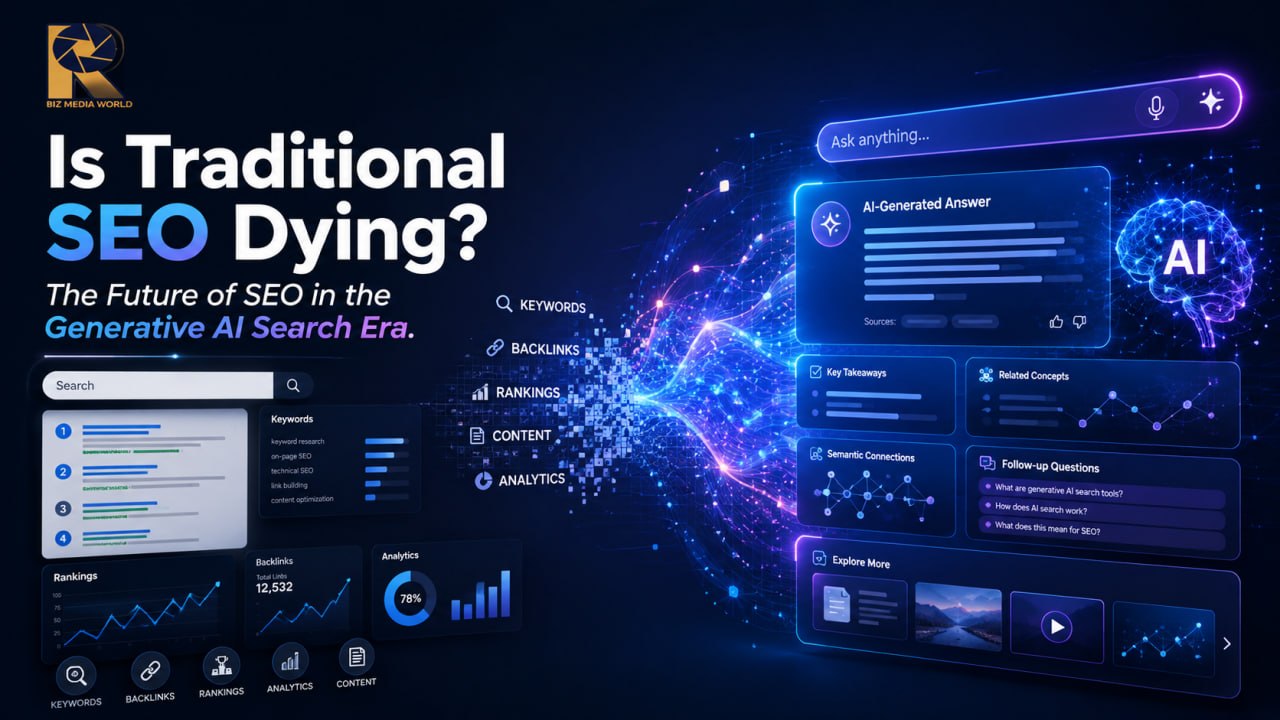
Is Traditional SEO Dying? Future of SEO | Ritz Media World
Ask around any marketing team right now and someone will bring up how strange search feels lately. Questions get answered before a person even reaches the results page. For a Digital Marketing agency, this shift is impossible to ignore. AI-generated summaries sit at the top, often good enough that nobody clicks further. It makes sense the same question keeps popping up: is SEO dead, or has it just changed shape?
It hasn't died. But pretending nothing has changed would be its own kind of mistake. Generative AI search has moved enough furniture around that old habits, built around ten blue links and a handful of target keywords, don't get the job done alone anymore. Getting a handle on where search engine optimization trends are actually headed matters more than following a checklist from three years ago.
From Search Engines to Search Experiences
There was a stretch of about twenty years where ranking meant one thing: show up somewhere on that first page of ten links. That era is winding down. Google's AI Overviews sit above the fold now. Bing runs Copilot right inside search. And separate from all that, tools like ChatGPT, Perplexity, and Claude have become places people go to ask questions directly, skipping search engines altogether.
People used to hunt across several tabs, piecing an answer together themselves. Now a lot of that work happens for them, condensed into one paragraph pulled from a handful of sources. That's not the end of optimization, just a different scoreboard. A page that's genuinely clear and well organized has a real shot at getting pulled into one of these AI answers. A page stuffed with the same phrase repeated ten times does not.
Which is really what the future of SEO comes down to. Ranking for a crawler was always a proxy for getting in front of people. Now that proxy includes AI systems deciding what counts as trustworthy enough to reference.
Is SEO Dead? Not Quite, But It's Not the Same Game
Every so often, some new technology shows up and "SEO is dead" makes the rounds again. Social media did it. Voice search did it. Generative AI is doing it now, and the headline gets a little tired each time it resurfaces. What keeps SEO alive through all of it is simple: the goal was never really about search engines specifically, it was about helping people find something useful, and that hasn't gone anywhere.
What's actually shifted is the terrain. Search engine optimization trends now stretch past a results page, into getting mentioned inside an AI-written summary, showing up in a chatbot's answer, holding credibility across more than one platform at a time. This is where AEO and GEO in SEO become increasingly relevant, helping brands optimize their content for answer-focused and generative search experiences.
So no, SEO isn't dead. What's dying off, and deserves to, is SEO built on shortcuts: keyword stuffing, thin pages thrown together just to rank, backlinks bought in bulk from nowhere in particular. Companies still seeing traffic grow moved on from that stuff a while ago and picked up modern SEO strategies instead.
Generative AI search refers to any kind of search interaction where a language model outputs a proper answer rather than generating a bunch of links. The Google AI Overviews, the Bing Chat, and various assistants - all of these are essentially implementing something similar, searching through all sorts of information available on the web, processing it, and generating a single answer that looks like it was written by a person. That's a real change in how content gets used. A click used to mean traffic to a specific site. Now five or six sources might get blended into a single paragraph somewhere, sometimes with a citation attached and sometimes without. Under the hood, most of these systems work in two rough steps. First, something gets retrieved, relevant material pulled from an index based on what was asked. Then a language model reshapes that material into something readable, closer to a person explaining it out loud than a database dump. Getting picked up in that first step usually comes down to a few things: The content actually answers the question, without three paragraphs of setup first There's real depth on the topic, not just one article that happened to do well once The page is technically easy to crawl and parse Something backs up the credibility of it all: real data, a named expert, sources worth trusting All of this is far from happening independently. AI search optimization involves much more than just inserting relevant keywords into a text. This is about writing as an expert would talk to a person interested in the topic. E-E-A-T, Google's shorthand for Experience, Expertise, Authoritativeness, and Trustworthiness, isn't new. But it matters more now that AI models are the ones summarizing things on a company's behalf. These systems tend to favor content that reads as credible. Businesses putting a real name behind what they publish, getting facts right, showing actual expertise, keep showing up more often in AI-generated answers than the ones that don't. Schema markup, logical headings, content organized so it actually makes sense, these help more than just a person skimming a page. They help AI models figure out what a page is even about. Clean HTML and clearly labeled FAQ sections make it easier for these systems to pull something accurate without garbling the meaning. As more people talk to AI tools like they'd talk to a person, long-tail and conversational queries are becoming a much bigger deal. Nobody types "best running shoes" into a chatbot and calls it a day. It's more like "what are decent running shoes for flat feet that won't break the bank." Content shaped around questions like that tends to do better in generative AI results than content built around a short, generic keyword. The mindset shift matters more than any single tactic: content has to inform before it tries to rank. A few things help along the way: Answer the actual question early, don't bury it under a long windup Write headings the way people actually phrase questions Back claims up with real data or expert insight instead of vague statements Keep older pages updated since freshness still counts as a signal Cut anything that pads word count without adding value Search visibility in AI results is rarely about one page carrying all the weight. It's built slowly, across a wider footprint: Getting mentioned and cited on other reputable sites Publishing original research or data other publishers actually want to reference Keeping facts consistent everywhere a brand shows up Earning digital PR and backlinks from publications with real credibility The point is to be findable wherever AI systems are looking for something reliable, not just on a company's own homepage. For anyone wondering how to rank in AI search, a few steps tend to matter more than the rest: Audit what's already out there. Outdated facts and messy structure drag pages down more than people realize. Add structured data. FAQ schema, article schema, organization schema, all of it helps AI read a page correctly. Go deep on fewer topics. Comprehensive beats scattered almost every time. Keep the page experience solid. Load speed and clean navigation still affect crawlability. Build actual authority. Named experts and consistent publishing in one lane go further than chasing every trend. Watch where a brand shows up. Tools exist now to track appearances inside generative AI answers directly. None of this is some brand-new discipline. It's mostly sharper execution of what SEO always demanded, just applied to a wider set of places. Generative AI search builds on top of search engine optimization. It doesn't tear it down. Further out, the future of SEO probably looks like a blend, traditional ranking factors sitting alongside AI-specific optimization rather than one replacing the other. Companies will need to think past any single search engine and pay attention to how content performs across several AI platforms, voice assistants, and regular search results at once. Measurement is shifting too. Click-through rate alone won't carry the whole story much longer. More companies will start tracking brand mentions inside AI-generated answers and something like a share of voice across those responses. It's messier than a clean ranking number, but it matches how fragmented search has actually become. Quality, accuracy, and real expertise stay the foundation, that part isn't going anywhere. What's different is who's reading the content. It's not only a person scrolling anymore, it's also a system quietly parsing and summarizing that content on someone else's behalf. Traditional SEO isn't dying. It's going through one of the bigger shifts it's faced in years. Generative AI search rewrote a good part of the rulebook around visibility, and what wins attention now is content that's accurate, well-organized, and genuinely useful rather than just packed with keywords. Companies leaning into modern SEO strategies, optimizing for AI search, and putting in the work on real expertise will hold a stronger position no matter where the technology goes from here. The future of SEO is really about building trust over time, not checking off a list and calling it done. Search engines need to trust your content, and now AI systems do too. If you're looking for practical ways to strengthen your online presence and keep up with how search is changing, Ritz Media World is here to help.What Generative AI Search Actually Means
How AI Search Actually Finds and Uses Content
The Trends Actually Worth Paying Attention To
Structure Isn't Just for Human Readers Anymore
People Are Asking Longer, Weirder Questions
Putting Modern SEO Strategies Into Practice
Writing Content That Actually Works for AI Search
Earning Visibility Across the Wider AI Search Landscape
How to Actually Rank in AI Search
Where the Future of SEO Seems to Be Headed
Final Thoughts